
A Market Moving at the Speed of LifeJuly gave us a clear look at the Denver Metro market as it is: measured, patient, and increasingly shaped by life circumstances. Moves are happening less because

Dated: June 20 2022
Views: 25
A quick anecdote before we dive into the current state of housing inventory: While most of us have started to sweat every time we fill up our gas tanks or pay the energy bill, wealthy buyers in Aspen are trying to outbid each other on ultra luxury homes that are not even for sale. As first reported by the Wall Street Journal earlier this month, the Aspen luxury market has been supercharged by extremely low inventory, tight restrictions on new home construction, and an influx of buyers. Not dissimilar to what has been happening in the rest of Colorado… but what is quite different are the price points.
Aspen has seen an extreme number of $50 million and up home purchases since the pandemic hit. So many, that even uber wealthy buyers are struggling to find a house in the ski resort town. It has become common for their real estate agents to cold call homes that have not even hit the market, in hopes their offers will be so attractive that the owners will sell. This has created a sort of “shadow market” where these luxury mansions are sold before the listings go public. 2021 was such a hot year for Aspen real estate, one house even set a record purchase price of $72.5 million.

Back in real life, the real estate market is starting to slow. As a local example, housing inventory in Metro Denver is increasing. The number of active listings at the end of May was up for the first time in recent memory, at +7.9% from April, or 4,051 active listings.
This rise in inventory is a sure sign that things are beginning to cool off, and that the buyer pool has started to thin out. Some have undoubtedly been priced out of the market, given high average home prices and mortgage interest rate hikes. Plus, high inflation for everyday items like gas and eggs adds up fast. This increase in inventory is much needed for the remaining buyers, who have suffered through some of the worst housing scarcity to date. Things should be a little less competitive right now than they have been over the past two years, and the marketing time for listings is likely to increase over time.
On the flip side of the coin, some sellers are looking to capitalize on their equity and move or trade-up before interest rates get much higher, and are no doubt getting a little bit panicky about a looming recession. For sellers who must make a move right now: just remember, this is still a seller’s market. Buyers may be less willing to waive their concessions, but demand is still high for homes.

One crucial thing to note about these recent changes is that the increase in active housing inventory, the slowdown in home price appreciation, and the rise in interest rates are all factors that are likely bringing us closer to a more “normal” real estate market, not towards a housing crash. Housing inventory was already historically low when the pandemic hit, and then the move to remote work drove demand even higher. The net result was that historically low inventory, around 8,000 homes for sale in December 2019, was driven even lower into the red. At times over the past couple years the inventory was as low as about 1,000-1,200 homes for sale at one time in the entire Denver metro. Wow.
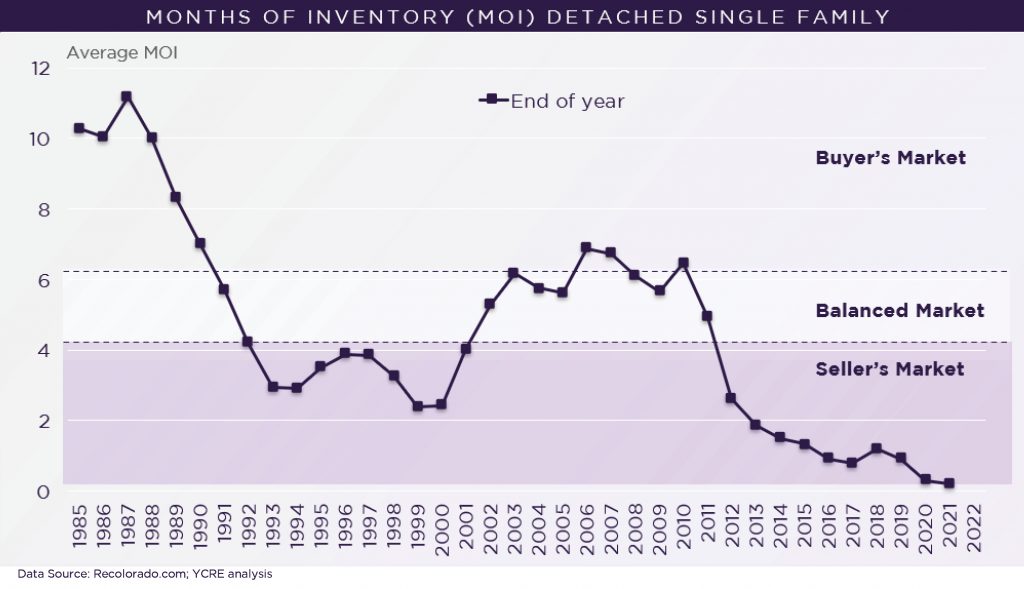
In terms of price appreciation, having radical appreciation as we have seen over the past couple of years is not sustainable over the long term. The Denver Business Journal stated that Denver is one of the Top 5 Least Affordable cities in the country, for the first time ever. The fact that price appreciation is slowing down recently, but still continuing to grow at a slower pace, is actually good for the balance of the local market. Plus, a recession does not necessarily equal home price depreciation. Given genuine demand for homes and a scarcity of supply, slower paced price appreciation is the more likely scenario this time around.
Lastly, mortgage interest rates were also already at historic lows when the pandemic stuck. The FED drove those even lower to combat inflation. We hit an all-time record low in December 2020: 2.68%. Although rates have been on the rise lately, they are still on the low end, historically. All these factors point to a real estate market that is simply slowing down from its fervent pace over the past two years.

Whether you are buying or selling, you need to know what’s happening in the housing market, so you can make the most informed decision possible. Let’s connect to discuss your goals so you can pick your best time to make a move.
A Market Moving at the Speed of LifeJuly gave us a clear look at the Denver Metro market as it is: measured, patient, and increasingly shaped by life circumstances. Moves are happening less because
A Market Moving at the Speed of LifeJuly gave us a clear look at the Denver Metro market as it is: measured, patient, and increasingly shaped by life circumstances. Moves are happening less because
Buyers Are Looking Beyond the Price TagAs summer settles in, the Denver Metro market is becoming increasingly divided. Detached and attached homes continue to tell different stories, while
Buyers Are Looking Beyond the Price TagAs summer settles in, the Denver Metro market is becoming increasingly divided. Detached and attached homes continue to tell different stories, while an
Should you require assistance in navigating our website or searching for real estate, please contact our offices at 303-962-4272.
 The content relating to real estate for sale in this Web site comes in part from the Internet Data eXchange (IDX) program of METROLIST, INC., DBA RECOLORADO©. Real estate listings held by brokers other than Your Castle Real Estate are marked with the IDX Logo. This information is being provided for the consumers' personal, non-commercial use and may not be used for any other purpose. All information subject to change and should be independently verified. September 12, 2026 8:04 PM UTCd
1. This publication is designed to provide information regarding the subject matter covered. It is displayed with the understanding that the publisher and authors are not engaged in rendering real estate, legal, accounting, tax, or other professional services and that the publisher and authors are not offering such advice in this publication. If real estate, legal, or other expert assistance is required, the services of a competent, professional person should be sought.
2. The information contained in this publication is subject to change without notice.
METROLIST, INC., DBA RECOLORADO MAKES NO WARRANTY OF ANY KIND WITH REGARD TO THIS MATERIAL, INCLUDING, BUT NOT LIMITED TO, THE IMPLIED WARRANTIES OF MERCHANTABILITY AND FITNESS FOR A PARTICULAR PURPOSE. METROLIST, INC., DBA RECOLORADO SHALL NOT BE LIABLE FOR ERRORS CONTAINED HEREIN OR FOR ANY DAMAGES IN CONNECTION WITH THE FURNISHING, PERFORMANCE, OR USE OF THIS MATERIAL.
3. PUBLISHER'S NOTICE:
All real estate advertised herein is subject to the Federal Fair Housing Act and the Colorado Fair Housing Act, which Acts make it illegal to make or publish any advertisement that indicates any preference, limitation, or discrimination based on race, color, religion, sex, handicap, familial status, or national origin.
4. METROLIST, INC., DBA RECOLORADO will not knowingly accept any advertising for real estate that is in violation of the law. All persons are hereby informed that all dwellings advertised are available on an equal opportunity basis.
5. 
6. © 2026 METROLIST, INC., DBA RECOLORADO© - All Rights Reserved
6455 S. Yosemite St., Suite 500
Greenwood Village, CO 80111 USA
7. ALL RIGHTS RESERVED WORLDWIDE. No part of this publication may be reproduced, adapted, translated, stored in a retrieval system or transmitted in any form or by any means, electronic, mechanical, photocopying, recording, or otherwise, without the prior written permission of the publisher. The information contained herein including but not limited to all text, photographs, digital images, virtual tours, may be seeded and monitored for protection and tracking.
Options
Show More...
 Information deemed reliable but not guaranteed by the MLS. © 2026 Information and Real Estate Services, LLC.
Information source: Information and Real Estate Services, LLC. Provided for limited non-commercial use only under IRES Rules. © Copyright IRES.
The information being provided is for the consumers personal, non-commercial use and may not be used for any purpose other than to identify prospective properties consumer may be interested in purchasing.
The IRES, LLC Data on this
site was last updated: September 12, 2026 8:53 PM UTC
Information deemed reliable but not guaranteed by the MLS. © 2026 Information and Real Estate Services, LLC.
Information source: Information and Real Estate Services, LLC. Provided for limited non-commercial use only under IRES Rules. © Copyright IRES.
The information being provided is for the consumers personal, non-commercial use and may not be used for any purpose other than to identify prospective properties consumer may be interested in purchasing.
The IRES, LLC Data on this
site was last updated: September 12, 2026 8:53 PM UTC
This site is used and paid for by multiple independent companies. The real estate broker cannot require you as a prospective buyer to pre-qualify with or utilize the services of either of the mortgage loan originators. Nor can either of the mortgage load originators require you as a prospective buyer to utilize the services of the real estate broker.
Show More...
 The real estate listing information and related content displayed on this site is provided exclusively for consumers� personal, non-commercial use and may not be used for any purpose other than to identify prospective properties consumers may be interested in purchasing. This information and related content is deemed reliable but is not guaranteed accurate by elevateMLS.
 IDX information is provided exclusively for personal, non-commercial use, and may not be used for any purpose other than to identify prospective properties consumers may be interested in purchasing. Information is deemed reliable but not guaranteed. Copyright © 2026 Vail Multi List, Inc. (VMLS)
The listing broker's offer of compensation is made only to participants of the MLS where the listing is filed.
IDX information is provided exclusively for personal, non-commercial use, and may not be used for any purpose other than to identify prospective properties consumers may be interested in purchasing. Information is deemed reliable but not guaranteed. Copyright © 2026 Vail Multi List, Inc. (VMLS)
The listing broker's offer of compensation is made only to participants of the MLS where the listing is filed.
 Pueblo Association of REALTORS®, Inc. All information deemed reliable but not guaranteed. All properties are subject to prior sale, change or withdrawal. Neither listing broker(s) or information provider(s) shall be responsible for any typographical errors, misinformation, misprints and shall be held totally harmless. Listing(s) information is provided for consumer's personal, non-commercial use and may not be used for any purpose other than to identify prospective properties consumers may be
interested in purchasing. The data relating to real estate for sale on this website comes in part from the Internet Data Exchange program of the Multiple Listing Service. Real estate listings held by brokerage firms other than Your Castle Real Estate may be marked with the Internet Data Exchange logo and detailed information about those properties will include the name of the listing broker(s) when required by the MLS. Copyright ©2026 All rights reserved.
Last Updated: September 12, 2026 11:12 PM UTC
Show More...
Pueblo Association of REALTORS®, Inc. All information deemed reliable but not guaranteed. All properties are subject to prior sale, change or withdrawal. Neither listing broker(s) or information provider(s) shall be responsible for any typographical errors, misinformation, misprints and shall be held totally harmless. Listing(s) information is provided for consumer's personal, non-commercial use and may not be used for any purpose other than to identify prospective properties consumers may be
interested in purchasing. The data relating to real estate for sale on this website comes in part from the Internet Data Exchange program of the Multiple Listing Service. Real estate listings held by brokerage firms other than Your Castle Real Estate may be marked with the Internet Data Exchange logo and detailed information about those properties will include the name of the listing broker(s) when required by the MLS. Copyright ©2026 All rights reserved.
Last Updated: September 12, 2026 11:12 PM UTC
Show More...
